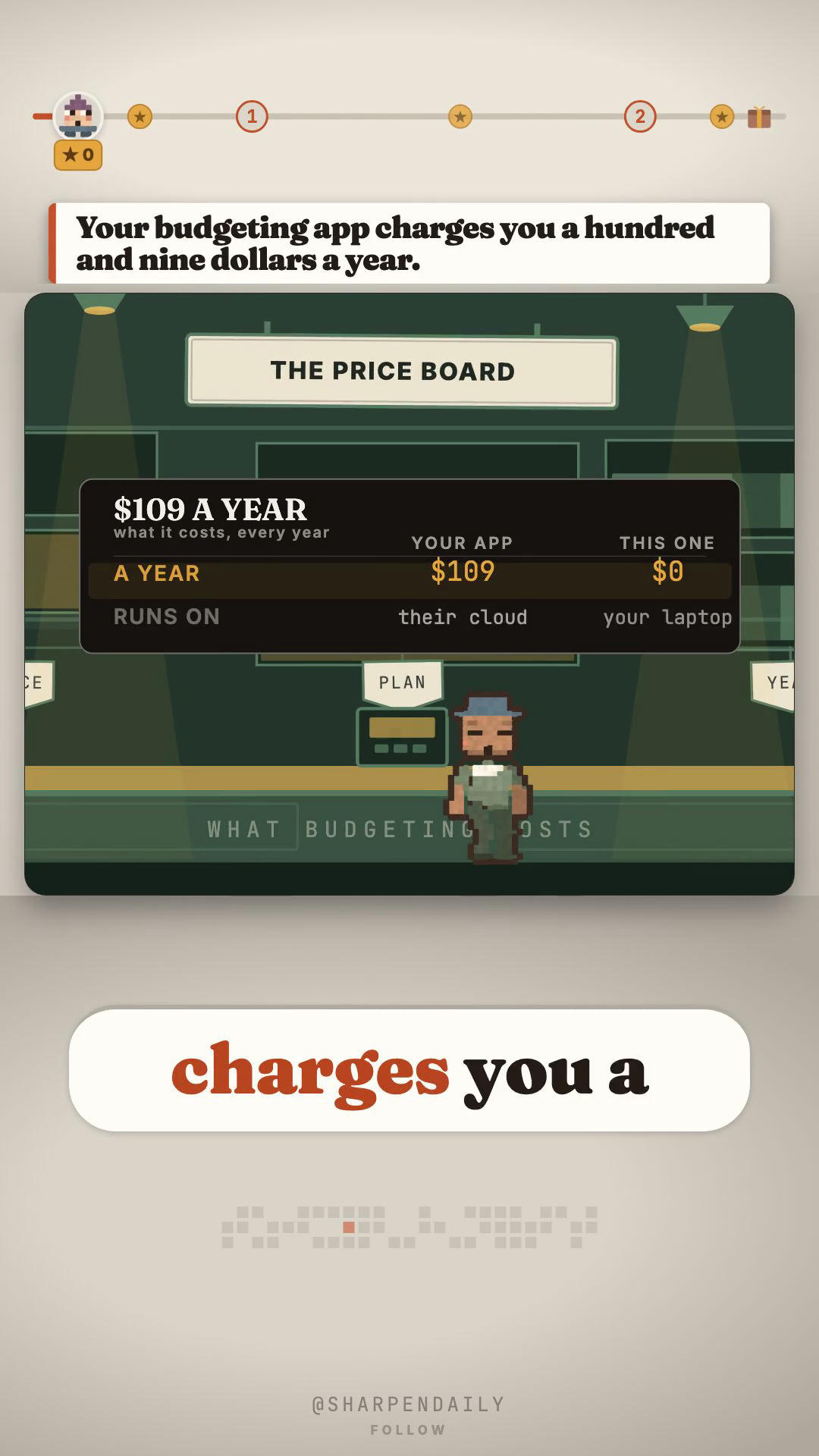
# The budgeting app is $109 a year. This one is free, and it will import your data.
YNAB costs $109 a year, or $14.99 a month. That is the real number from their own pricing page — not the $180 you get if you annualise the monthly plan, which is a figure no annual subscriber actually pays.
Actual Budget is free, MIT licensed, and runs on your own computer. It has 28,679 stars and 76 commits in the last thirty days, so it is not a project someone abandoned.
And it will import your data straight out of the paid one.
The part that makes this a real switch
There is an official importer for YNAB's current format. You export your budget, then Import file → nYnab. The repo documents the whole path in packages/docs/docs/migration/nynab.md. It is not a spreadsheet-and-pray migration.
That matters more than any feature comparison. The reason people stay on a subscription they resent is that leaving means retyping four years of history. This removes that.
What you actually get
| Envelope budgeting | the same method, as the default |
| Split transactions | real parent/child splits |
| Transfers | including transfers inside a split |
| Rules | a genuine rules engine — conditions, actions, an indexer |
| Reports | net worth, cash flow, and eleven more |
I checked each of these against the source rather than a feature list. "Rules" in particular is a real engine at packages/loot-core/src/server/rules/, not a marketing word for saved filters.
What it costs, stated plainly
The app is free. Bank sync is not.
Automatic bank import goes through SimpleFIN, at $1.50/month or $15/year — a third party, not Actual. That figure is in Actual's own docs at packages/docs/docs/advanced/bank-sync/simplefin.md.
Two things almost nobody mentions, both of which you should know before you start:
The free European route is closed. GoCardless stopped accepting new Bank Account Data accounts in July 2025. Actual's own documentation says so. If you are in the EU or UK and starting today, you cannot take the free path that older blog posts describe.
Encryption is opt-in, and it has a hole. End-to-end encryption is real, but you switch it on in Settings; it is not the default. And the docs are explicit that bank-sync tokens are stored separately on the server and are not covered by it.
None of that makes it a bad deal. Fifteen dollars a year against a hundred and nine is still the whole argument. But a tool that costs money in one specific place should say so in that place.
Getting it running
docker run --pull=always --restart=unless-stopped -d -p 5006:5006 \
  -v YOUR/PATH/TO/DATA:/data --name my_actual_budget \
  actualbudget/actual-server:latest
One command. Docker is the only prerequisite.
Repo: <https://github.com/actualbudget/actual>
If you would rather not run Docker at all, there is a real desktop app for Windows, Mac and Linux that bundles the server with the client. It is not a web page in a wrapper.
Sync between your phone and laptop runs through a server *you* run. There is no native mobile app — you install the web app to your home screen — but the sync itself has no company in the middle, which is the part that matters.
The checker
ledger_check.py in the kit reads your clone and prints the cost claims back to you with the file that carries each one. If the wording in their docs changes, it tells you to go read it yourself rather than repeating something stale.
It reads only. It writes nothing, installs nothing, and sends nothing.
Comment LEDGER and I'll send you the setup.