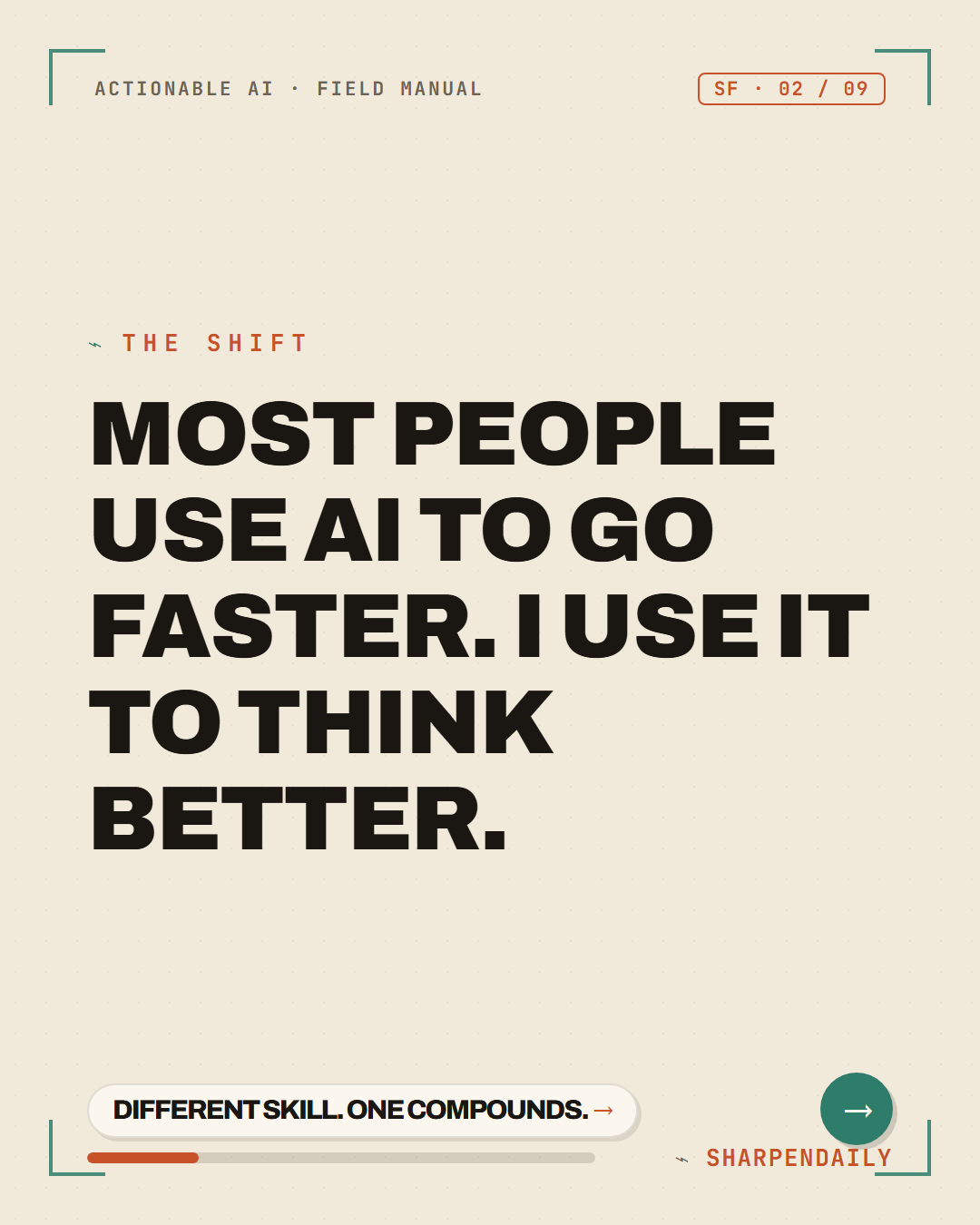
Most people use AI to produce faster. Write the email in 30 seconds instead of 5 minutes. Summarize the article instead of reading it.
That's fine. But it's not compounding.
These 5 prompts are different. They use AI to think better — to see what you're missing, say what you actually mean, catch the flaw before it costs you. One for every domain that matters.
Save this. Use it this week.
## Prompt 01 — Learning: The Feynman Prompt
Use this when you want to actually understand something, not just know what it is.
Paste all 4 lines at once. Works on any topic.
"Explain [topic] like I've never heard it. One paragraph."
"WHY it works — not just what. Assume I have the basics."
"One idea inside this that experts actually argue about."
"After each: the best follow-up question to go deeper."
Why it works: Most AI explanations stop at the definition. This prompt forces it past what it is, into why it exists, what's contested, and where to go next. You leave with a mental model, not a summary.
Use cases:
- Learning a new concept before a meeting
- Understanding a technical term someone used in a document
- Building background on a topic before writing about it
- Replacing 45 minutes of reading with 20 minutes of structured Q&A
## Prompt 02 — Writing: The Brutal Editor
Use this after you write a draft. Not before — after.
"Here is my draft: [PASTE YOUR TEXT]"
"Find weak sentences, filler words, repetitions."
"Don't rewrite — flag each problem clearly."
"Which single cut makes this 50% shorter now?"
Why it works: The key line is "don't rewrite — flag each problem clearly." Most AI tools rewrite your draft and you get their words, not yours. This one shows you what's wrong and makes you decide.
Result: 40% shorter, twice as hard. Your voice, not AI's.
Use cases:
- Cold email or DM you've been overthinking
- Performance review you're writing for yourself
- LinkedIn post that feels too long
- Any written pitch where every word costs you attention
## Prompt 03 — Planning: The Pre-Mortem
Use this before you commit to a plan. Not after it fails.
"Here is my plan: [PASTE YOUR PLAN]"
"Assume it failed. Give me 3 exact reasons."
"My worst assumption + first thing to fix."
"What would have to be true for this to work?"
Why it works: Your brain is optimistic about your own plans. AI has no emotional stake. The phrase "give me 3 exact reasons" prevents vague feedback — it forces specificity about what breaks first.
Use cases:
- Business plan or side project before you invest time
- Product launch or campaign before spend
- A decision you're about to make that you can't easily reverse
- Any plan where you're the most motivated person in the room
## Prompt 04 — Reflection: The Weekly Truth
Use this every Sunday. Takes 5 minutes.
"Here are my notes from this week: [PASTE]"
"Find the pattern. What did I keep avoiding?"
"Give me the uncomfortable truth about my energy."
"What's the ONE thing I should change next week?"
Why it works: Weekly reviews usually stay surface-level: what I did, what I didn't finish. This prompt asks for the pattern underneath — the thing you kept pushing off, where your energy actually went, and one specific change (not a list).
Use cases:
- Sunday evening review using your week's notes or calendar
- End-of-month check-in
- After a week that felt off but you can't name why
- Anyone who reviews their week and keeps writing the same things
## Prompt 05 — Automation: The System Builder
Use this when a process keeps breaking down the same way.
"Here are my notes on this process: [PASTE]"
"Find 3 places where it breaks down."
"Write a simple workflow + a 3-step checklist."
"Make it easy enough that I'll actually run it."
Why it works: The last line — "make it easy enough that I'll actually run it" — is the one most prompts skip. A 20-step system is a system you'll abandon. This prompt builds for sustainability, not for impressiveness.
Use cases:
- Client onboarding or offboarding process
- Content creation pipeline
- Weekly operational tasks you always do inconsistently
- Any repeating process that works great sometimes and breaks the other times
## How to use all 5
| Prompt | When to use | Input needed |
|--------|-------------|---------------|
| Feynman Prompt | Before or during learning | A topic name |
| Brutal Editor | After writing any draft | Your draft text |
| Pre-Mortem | Before committing to a plan | Your plan text |
| Weekly Truth | Every Sunday evening | Your week's notes |
| System Builder | When a process keeps failing | Process notes |
## What most people get wrong
They use these once, get a good result, and don't build the habit.
The Feynman Prompt works every time you encounter a new concept. The Weekly Truth only compounds if you run it every week. The Pre-Mortem only catches problems if you run it before — not after.
Schedule them. Put "Brutal Editor" in your writing process. Put "Weekly Truth" on your Sunday calendar. The prompts aren't the product. The habit is.
## One step to take today
Pick the one prompt that matches where you're stuck right now. Run it once, on a real thing — not a test.
If you're writing something: Brutal Editor.
If you're planning something: Pre-Mortem.
If you're learning something: Feynman Prompt.
Run it now.